Lower Saxony's future lab for the circular economy
Initial situation and problem definition
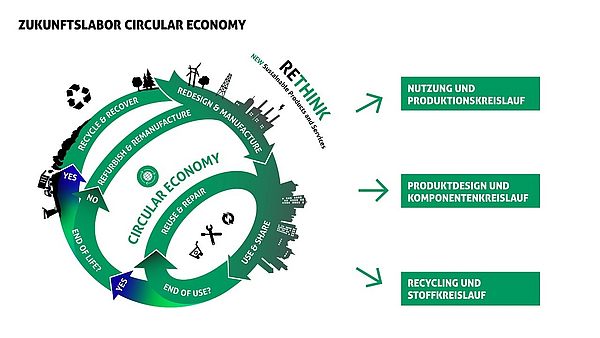
The increasing scarcity of resources, rising global material consumption and climate change require a fundamental change in industrial production methods - away from the linear "take-make-waste" logic towards a circular economy (CE). In industrial manufacturing in particular, there has been a lack of end-to-end transparency across the product life cycle, standardized digital information models and structured concepts for the reuse of components. There is also a lack of intelligent technologies for dismantling, sorting and recycling products. Added to this is the lack of socially accepted business models that promote repair, return and sustainable use. Without consistent digitalization in combination with technical innovations and systems thinking, an effective implementation of the circular economy is not feasible. This is where the project comes in.
Project goals
The ZL-CE meets the challenges of the circular economy with a systemic, interdisciplinary research approach. The focus is on digital technologies such as digital twins, product passports, AI-supported analyses and networked data platforms that are used along the entire product life cycle. The aim is to develop
- sustainable business models (e.g. product-as-a-service, sharing, repair platforms),
- digitally supported methods for circular design and re-use,
- intelligent recycling processes using AI, sensor technology and automation,
- open data infrastructures for transparent decisions and
- practical real-world laboratories for testing and social anchoring.
These approaches will be prototypically implemented in four real-world laboratories in Lower Saxony, validated using real products and made transferable across sectors. The results flow into an open knowledge base and strengthen innovation and sustainable value creation at regional, national and international level.
Solution approach
The IMW identifies product characteristics relevant to the circular economy and develops validated guidelines for circular product design, with a focus on the reuse of used components. The aim is to design products that are already designed for disassembly, repair and recycling in the concept phase. In addition, the IMW creates reference scenarios that map the life cycles and recycling potential of exemplary products in a structured manner and make them comparable - including product structure, use, processes and options for reuse and material recycling.
Funding reference
Supported with funds from:

A joint science funding program of the Lower Saxony Ministry of Science and Culture and the Volkswagen Foundation and managed by the Center for Digital Innovation (ZDIN).

Image source: iStock_Urbanscape
Project duration
06.2024 - 02.2029
Interested project partners according to Letter of Intent (LOI)
- Technische Universität Braunschweig
- Ostfalia University of Applied Sciences
- University of Oldenburg,
- Leibniz Universität Hannover
- Fraunhofer Institute for Surface Engineering and Thin Films (IST)
- OFFIS - Institute for Information Technology
-Siemens AG
- Volkswagen AG
- Hellmann Process Management
- Electrocycling GmbH
- ceconsoft GmbH
- Glaub Automation & Engineering GmbH
- pdv-software GmbH
- SWMS Consulting GmbH
- WasteAnt GmbH
- Stadt Goslar
- Stiftung Digitale Chancen
- OHLF e.V., REWIMET e.V.
- ReparaturRat Oldenburg e.V.
- zentegra gGmbH
- Chamber of Industry and Commerce (IHK)
- Mittelstand-Digital Zentrum
Funding body
- Lower Saxony Ministry of Science and Culture
- Volkswagen Foundation