KI-P³ - AI-supported product and process planning for multi-variant products
Initial situation and problem definition
In increasingly customer-oriented markets, the number of variants is increasing, which puts small and medium-sized enterprises (SMEs) in particular under high cost, time and innovation pressure. Currently, planning is often based on empirical knowledge that is lost when experienced specialists leave the company. In addition, isolated data and process solutions make cross-departmental collaboration more difficult. The project addresses these challenges by systematically recording, networking and making available knowledge about product variants and reconfigurable production processes. The aim is to enable well-founded decisions and significantly increase efficiency, transparency and sustainability in product realization.
Project goals
The aim of the transfer project is to improve product and process planning through an integrated, data-driven methodology. The aim is to enable companies to increasingly reuse components and production steps in order to realize products more efficiently. To this end, existing product variants are systematically analyzed using CAD models, production characteristics and sales forecasts. This forms the basis for variant-optimized design and product structures as well as robust production processes. The project thus improves the quality of decision-making, increases the ability to react to market requirements and supports small and medium-sized companies in particular in sustainably increasing efficiency.
Solution approach
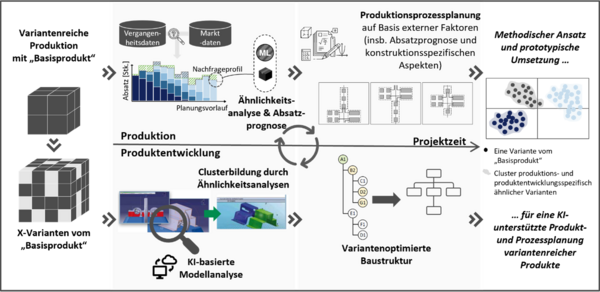
In the project, product development and production are systematically linked in order to improve the handling of product variants based on data. Existing products and components are examined using feature-based similarity analyses (e.g. 3D feature extraction, 3D-CNN) and clustering algorithms with regard to geometric and production-related similarities. In addition, ML-based sales forecasts are created on the basis of historical data and market analyses. The results are incorporated into variant optimization and production planning. The central element is a prototype software platform that integrates the developed methods. The aim is to harmonize product and production process planning in order to reduce the disruptive effects of variant diversity and increase the reuse of components. Pilot projects with industrial partners ensure practical testing. The project thus creates the basis for efficient, adaptable and scalable planning of multi-variant products in dynamic markets.
Project duration
06.2025 - 06.2026
Project partners
- Leibniz University Hannover, Institute for Factory Systems and Logistics (project management)
- Wilhelm Ewe GmbH & Co. KG
- Sennheiser electronic SE & Co. KG
Funding body
- Lower Saxony Ministry of Science and Culture
- Volkswagen Foundation