Junior Research Project - Modeling Lifetime Heretrogeneity to Support Life Cycle Option Planning of Future Aircraft Systems
Initial situation and problem definition
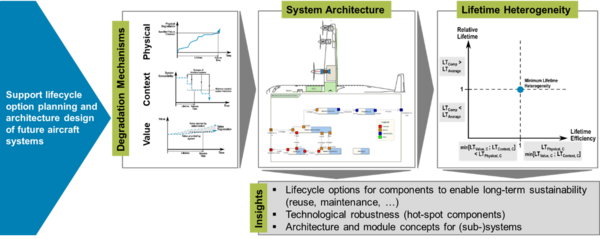
Future aircraft systems are facing profound architectural changes due to new technologies such as electric propulsion and energy storage. While previous systems have been based on well-researched service life models and failure rates, the service life characteristics of these new subsystems are hardly known and differ fundamentally. This leads to a new service life heterogeneity within the overall system, which makes planning, maintenance and reuse considerably more difficult. Existing architecture and maintenance concepts are no longer sufficiently effective here. As a result, it is necessary to model and consider service life heterogeneities at an early stage - for example with regard to maintenance, retrofitting, reuse and recycling. These aspects are becoming a central criterion for the sustainable design of future aircraft systems.
Project goals
The project aims to establish lifetime heterogeneity as a central evaluation criterion in the development of future aircraft systems. To this end, methods are to be developed to systematically record and model the different lifetime characteristics of components and subsystems and to take them into account in architecture planning. The aim is to select and evaluate life cycle options - such as maintenance, refurbishment, reuse or recycling - on this basis. This contributes to sustainable system development. In addition, the transferability of existing methods from automotive and robotics research to aviation will be tested and expanded.
Solution approach
The Junior Research Project combines approaches from system architecture, life cycle planning and reliability engineering in order to analyze the effects of new technologies such as electric drives and energy storage systems on system service life. The methodological focus is on the model-based recording and evaluation of technological differences, degradation behavior and functional dependencies of subsystems. The resulting lifetime diversity is modeled as a central feature for architectural decisions and life cycle strategies. Methods of structural complexity management, change analysis and release engineering are used. Cooperation with projects from the SE²A sub-areas of energy supply, electrical drives and overall design ensures the linking of different system levels. The aim is to provide reliable models for evaluating maintenance, retrofitting and sustainable reuse. The results serve both the further development of engineering methods and the strategic planning of durable, sustainable aircraft systems.
Project duration
04.2020 - 12.2021
Project partner
- Braunschweig University of Technology, Cluster of Excellence SE²A - Sustainable and Energy-Efficient Aviation
Funding body
SE²A - Sustainable and Energy-Efficient Aviation (German Research Foundation)