Lower Saxony Future Mobility Lab - Collaborative Research Field I
Initial situation and problem definition
Future mobility solutions are characterized by significant technical changes, such as dynamic system behaviour, intensive networking of vehicle and infrastructure, connection to the Internet of Things or the use of on-demand services. This results in new or additional requirements for the product to be developed and increased product and development complexity. The application of model-based systems engineering (MBSE) helps to better manage this complexity through the use of formal models. In particular, interdisciplinary development activities, such as the development of system architectures, can be supported by MBSE. However, the use of digital models in product development also entails challenges, such as maintaining model consistency. Inconsistencies between different models often lead to development errors and thus to additional development iterations.
Project goals
The overarching goal of the project is to increase development efficiency in model-based systems engineering. In particular, ensuring model consistency and the reuse of existing knowledge are considered key factors. Specifically, this project aims to develop the modeling technique Heterogeneous Models. In addition to the development of the modeling concept, its technical implementation is also planned. The expected benefit of the modeling technique lies both in more informative models for the specific development task and in the support of modeling activities.
Solution approach
As a solution approach, this project intends to develop a modeling technique that integrates different model elements into a common model, see Figure 1. These heterogeneous models should on the one hand serve to generate more informative models for the specific development task and on the other hand contribute to ensuring model consistency. It is therefore intended to link the underlying data structure for the heterogeneous models.
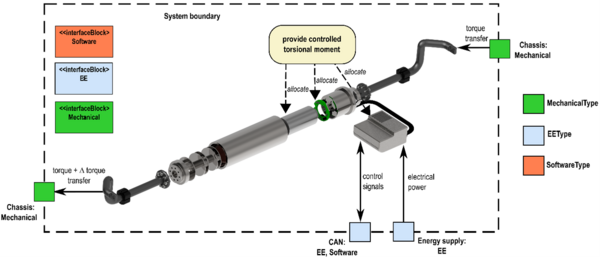
As a development principle, this project considers the development of products in generations. This principle implies that knowledge about the system to be developed is already available in the form of models from previous product generations.
Funding information
Funded by the Lower Saxony Ministry of Science and Culture under grant number ZN3493 in the Lower Saxony Advance of the Volkswagen Foundation and supervised by the Center for Digital Innovations (ZDIN).

Image source: Westend61/Uwe Umstätter
Project duration
10.2019 - 09.2024
Project partners
- Ostfalia University of Applied Sciences
- Carl von Ossietzky University of Oldenburg
- TU Braunschweig
Funding body
- Lower Saxony Ministry of Science and Culture
- Volkswagen Foundation
Funding code
ZN3493